Tuesday, July 3, 2018

Isaac


I have said it before and I will say it again: I actually pity the parents of our Noah’s Ark children who threw their kids away and never get to see and know the amazing boys and girls to whom they gave birth. They thought they were giving up someone worthless, but that is only because they miss every goofy smile, every new word she can read, every dance presentation in church and every tower he builds to knock down. We are the privileged ones. We get to see these beautiful and hilarious and valuable children day in and day out. And I will tell you, they are some of the most awesome people on the planet. I’d like to introduce you to a particularly awesome boy of mine—Isaac. 

Isaac was found in 2010 on the street in a village outside Kampala. He was only six months old, give or take (Noah’s Ark almost always has to estimate a child’s age when he comes into the system because there is no one to tell us exactly how old he is, or even who he is and what his name is). He was healthy and seemed to be well cared for, but no one was able to trace him to a family or any relatives. He was given the name Isaac and though the first six months of his life remain a mystery, the following eight years he has lived happily at Noah’s Ark with all of his brothers and sisters who have similar stories.

I first remember meeting Isaac after I had been here about six months. It was December and we were at the beginning of our long holiday from school. I had taken a bunch of four-year-olds to church for an activity, and as usual we started with attendance. Even after being there for months I was still learning many names (there are about two hundred children, after all, not counting the ones who come from the community for school). We finished attendance and I asked if I had missed anyone. One small boy with crooked teeth and red eyes raised his hand. 

“What is your name?” I asked. 

“Isaac,” he said with a smile. He looked proud of it. 

I checked my list—no Isaac listed anywhere. “Is your mom an auntie?” Sometimes the aunties’ children also join the program and we don’t always have them on record at the beginning. He shook his head. “You live in the children’s home?” He nodded, still with a big smile. He was young and I didn’t know how well he understood what I was saying. Plus I did not recognize him at all. But I listened and added him to the list. 

In the coming two months I was privileged to spend more time with Isaac and his group of classmates. Turns out he was right—he did live in the home—and we had just missed him on our list. I made a point of saying his name every time I saw him so he knew I wouldn’t forget who he was after that (and because I was feeling a little bit guilty for not recognizing that he was even from the home). It wasn’t too long before he also sought me out, and we became buddies. 


For several months he had the tradition of visiting me on Saturday mornings before breakfast. The children wake up at 6:30 but don’t eat until 8:00, so he always had some time to kill. We would sit on my front step and point out all the colors we could see. Sometimes I got out different colored bottle caps and made him put them in a pattern or count them. It wasn’t until about a year ago that he could consistently remember the number seventeen. He could easily fit on my lap and didn’t mind when I gave him a big kiss on the cheek. 

In 2015 when he was in top class (the highest level of nursery school, equivalent to kindergarten) I went to his school on visitation day. Once every term the school holds a day for all parents to come meet the teachers and check on their children’s progress. It’s basically open house and parent-teacher conferences combined. Of course, on a compound like this with over one hundred schoolchildren and two official parental figures, things are a bit unconventional. I usually go to the school and see which children want me to check their work and talk with their teacher, and it is always an honor to do so. 

That day when I reached nursery school, a flying ball of energy gave a giant leap and literally wrapped himself around my legs, his arms and legs clinging to me so he was not touching the ground. “My parent!” he exclaimed. My heart melted. I was so happy to be his parent. 

Later that year, Isaac was struggling in school. He has a short attention span and wasn’t keeping up with the rest of his class. The special needs teacher was considering adding him to her program, but she already had more students than she could effectively handle. Instead, knowing Isaac and I were close, she asked me to step in. As motivation to do well in class, every Friday I came to his classroom and looked through his work from that week to see how he was doing. It was less seeing if he was performing well and more seeing if he was concentrating well enough to actually complete his work. When there was time we also worked on reading and math, with which he had been struggling. It was a fun time to sit down and give him individual attention, and for most of the year the motivation worked for him. It probably also helped that on weeks when he did well, after school I took him to the canteen (a small snack-and-basic-supplies shop on the compound) to get a treat. 

One Friday he chose a bottle of soda from the canteen. I wasn’t watching very closely as we walked back to my house, but apparently he was swinging his arms a lot because as soon as he sat down on my couch and opened his soda I heard that hissing and spraying noise that meant there would be a lot of cleaning up to do. It exploded all over him, my couch, my floor… 

The next week, he chose a doughnut. I noticed as we left the canteen that he was holding it in both hands, carefully and steadily in front of him. About halfway home, he said, “Auntie Katie, I’m not going to shake my doughnut.” And you know what? His doughnut never exploded. 

I love that kid. And I have never revealed to him that not all food explodes, because it seems good sense to just be careful with all food. 

Isaac is one of the most resourceful people I have ever met. Most of the children love Christmas day because they get new presents—toys, dolls, jewelry, bubbles, and the like. However, with no personal space except for their beds, most of the kids’ presents get broken or stolen or disappear within a matter of days or weeks. 

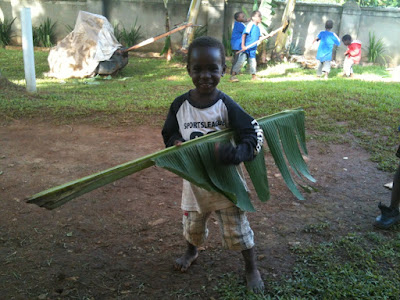
That is when Isaac moves in. He can find something broken and imagine up a brand new purpose for it. Take, for example, the burst beach ball that he wore as a hat for several days:


Or the stick and plastic bag that was an umbrella: 


Or his banana leaf guitar: 

Or his paint-bucket-lid shield: 


I love seeing how his mind works. He is not limited by what is; he sees what is possible. If only we, especially as adults, could all do that!

One day while playing at my house, Isaac put on a blanket as a cape and declared that he was a superhero. 

“Wow, that’s great!” I said. “What is your superhero name?” 

He pondered, “The… the… the woman!” Who doesn’t love a kid who calls women superheroes? 


The children all celebrate their birthdays in the children’s home. They get a cake, some presents, and all the children in the home sing to them while the birthday person sits a bit awkwardly in front of everyone. All children look forward to this celebration, but with over one hundred kids in the home, they celebrate multiple birthdays every week, so after time the festivities tend to lose their flare. For some of the children closer to us, Christian and I like to do something extra to make their birthday special. Last December, for Isaac’s eighth birthday, I gave him the choice of having a party with some friends at our house or going to Mukono (the nearest town) for lunch in a restaurant with one friend. Wisely, he chose the restaurant, since the kids don’t get to leave the compound very much and almost never see town. 

His birthday was on Saturday, so we moved out with Isaac and his friend, Jesse, for a day in town. We walked the half mile to the main road, during which Isaac narrated everything he saw on the way. We took a taxi (basically a bus system that uses 14-passenger vans) into Mukono and sat down at our favorite simple restaurant. Here, most small restaurants use stock photos in their menus, so what you can see is not actually what is offered. I told that to Isaac, but he still pointed to four or five different pictures before I finally asked if he just wanted chicken and he said yes. 


I had not considered what it would be like to eat in a restaurant with someone who had never eaten in a restaurant before. When other people went for the local food lunch buffet, Isaac kept asking, “Why can’t we eat now? They are eating—can’t we also get food? I’m hungry and food is right there!” And after our meal he got a toothpick, used it, and put it back in the container. At least he was trying to clean up after himself. 

We love being able to treat kids to new experiences, and sometimes it is so simple. 

Isaac is a special boy. He is not one of the children who flocks around every new volunteer—most of them never get to know his name. He is third last in second grade, has been held back a year, and struggles in school. He’s just starting to grow old enough to be “too cool” for things. He and his best friend, Noah, are great at creating mischief and getting into trouble. He is growing like a weed. He can run farther than some teenagers I know. And every time he leaves my house he asks for three things: a hug, a high five, and a kiss. It is a simple routine, and one I know he will soon outgrow, but for now I choose to cherish it… and him. 


all dressed up for our wedding
first time in a big swimming pool

Sunday, June 10, 2018

how I want to be

I have a friend. His name is Hosea. 

Hosea has been my friend for years now, but last week we became best friends. Want to know how? 

I let him hold a piece of string. 

No kidding. That was it. 

You see, last week during the holiday program I had some free time from leading and planning, so I decided to start putting up some of the kids’ crafts in the children’s home so they could admire their own handiwork. It would have been a simple task on my own, but I am trying to get more intentional about discipleship and inviting others into the everyday teachable moments, so I passed by the school to find a helper. Seven-year-old Hosea was the first one to catch my eye. 

“Do you want to help me with something at my house?” I asked. He nodded his head enthusiastically (as they always do), took my hand, and we set off. 

The decoration process was very simple. We measured a string so it would fit between two pillars in the children’s home, then took it to my house and got out paper aliens to string. (We had a space theme this holiday so I have literally hundreds of aliens hanging out in my spare room right now. It’s awesome.) I would put the string through one alien, then hand the end of the string to Hosea. He would keep it taught until I had slid the alien to the other end, and then he let go at just the right moment so I could tie a knot. Once the knot was tied, he scrambled to find the end again and we repeated the process. 

We did this for an hour, no joke. And actually, it was more helpful to have him there than to do it by myself. 

When we finally strung all the aliens that would fit, he ran to get Christian from the office and the three of us carried the artwork to the home and hung it up. We repeated the whole process once more, and that was the end of it. 

The next day when I went down to school, I saw out of the corner of my eye a rapid movement. Turning just in time, I found Hosea sprinting toward me and then he smacked into my legs, wrapping his short arms around my waist and giving me the biggest hug he could muster. These kids know how to melt your heart, I tell you. He stayed by my side as long as I let him. 

Now, every day when he sees me, he drops whatever he is doing and runs straight for me, arms outstretched, smile wide. Even today at school, as soon as I appeared at the end of lunch break, he came running across the field. It was nearing time for class so in an effort to get him and a classmate to go to their classroom, I told them to race each other. He sped off again, about fifty yards to the door of his classroom. He won. I clapped from a distance, but when he realized they had still not rung the bell for class, he made the run again and came back to my arms until it really was time to go. 

For the past week, if I don’t find Hosea at school or at the children’s home, he will find me at my house first. He walks across the verandah as if he is just passing by, but as soon as he catches my eye he giggles and is immediately sitting in the open doorway, content just to be there, or to read books if I take too long to get ready.

Sometimes Hosea shows his faith in me (or demonstrates his lack of forethought) when he jumps into my arms unexpectedly. No warning, no hesitation, just a run and a jump. What trust. 

That. All of that is how I want to be with God. 

As soon as I get a glimpse of Him, even in the distance, I want to run full speed into His arms. I want to race toward Him, arms outstretched and smile wide. I want to jump into His embrace, not hesitating to see if He is really paying attention or asking if He will catch me this time, but with an unwavering and uncomplicated trust that He will catch me. Again. And again and again and again. 


For an answer Jesus called over a child, whom he stood in the middle of the room, and said, “I’m telling you, once and for all, that unless you return to square one and start over like children, you’re not even going to get a look at the kingdom, let alone get in. Whoever becomes simple and elemental again, like this child, will rank high in God’s kingdom. What’s more, when you receive the childlike on my account, it’s the same as receiving me.” (Matthew 18:2-5, The Message)

Wednesday, November 22, 2017

Roman Road skit

Every Friday I lead part of an assembly for about 150 primary school students. Together with two teachers, we give a short Bible message and (try to) teach them a new song. A couple weeks ago I was trying to plan an assembly about salvation, and the idea of the Roman Road came up. Since we try to make the assemblies as fun and interactive as possible, we tend to do a lot of skits. I searched for Roman Road skits and found several options, but nothing that quite fit what we were wanting or able to do. In the end, I wrote my own version based  on some of the main Bible verses from the Roman Road. I wanted to include it here in case anyone else likes the idea of doing a skit and doesn’t feel like writing their own. 

This can take about five or ten minutes depending on how much acting you want to add in. I didn’t put too many notes because improv is more fun anyway. 

Disclaimer: You will need to make a car out of a cardboard box, but that is possibly the most fun part. 

____________________


Roman Road

Characters: 
Driver
Another Person
Other Person
(or Driver plus up to five other people to help hold signs and whatnot)


Driver enters the stage in his car. Without noticing, he goes past a sign with an arrow that says “Roman Road.” Driver looks really annoyed. 


Driver: Stupid, stupid, stupid… How could she, my own mother, tell me to get out and cool off? My brother was the one who started it! Every time we get in a fight she blames me. I did nothing wrong, I tell you! I am a good person who knows how to behave and I don’t need to be chased from home when I didn’t do anything wrong. I’M A GOOD PERSON!!! 

Driver stops as he reaches a yellow triangle sign held by Another Person that says, “For all have sinned and fall short of the glory of God. Romans 3:23.”


Driver: Okay, yeah, but not me. Sinners are just the really bad people. (The person holding the sign points to the word “all.”) Seriously? You mean I have also sinned? But all I did was call my brother a— (before he can finish the person points to the word “all” again. Driver keeps quiet, humbled.) Oh… um, I guess my mom was right… but I should keep going…

Driver continues down the road, deep in thought.

Driver: Okay, so I am a sinner. I can’t believe it… but really, sin isn’t that big of a deal is it? If I have sinned, it can’t be that bad. 

He stops as he reaches another sign held by Other Person. This one is red and says “For the wages of sin is death.”


Driver: Death? Not a time out? Not going to bed without supper? Death? Hmm, this sin must be more serious than I thought. But if we have all sinned, where is hope? 

Other Person turns the side around to a green side that says, “but the gift of God is eternal life. Romans 6:23.”  


Driver: Eternal life?! You mean through Jesus? I’ve heard of Him. Something how He died to save us from our sins. (He keeps driving, talking to himself.) Now that I know I am a sinner, I guess that means He died for me too. So… I have sinned and I deserve to die. But then Jesus came and died instead, so now I get to live? That doesn’t seem fair. Why would He do such a thing? Whoa! 

Driver stops suddenly when he notices another sign in front of him (held by Another Person), reading “But God shows His love for us, that while we were still sinners, Christ died for us. Romans 5:8.” 


Driver: But God shows His love for us… you mean He sent Jesus to die because He loves me?! God loves me? Even when I yell at my brother? Even when I skip school? Even when I fall asleep in church? Even when I tell little lies? And big ones? Wow, He must have a lot of love to love someone like me. He sounds like a pretty awesome God! (Starts driving again) He sounds so great, I’d like to stay with Him forever. Yes, that is exactly what I shall do—I shall follow God for the rest of my life… but how? 

A railroad crossing bar comes down in front of him, held by Other Person. Hanging from it is a sign, which Driver leans in to read:

Driver: “If you confess with your mouth that Jesus is Lord and believe in your heart that God raised Him from the dead, you will be saved. Romans 10:9”. I can do that! (shouting to the sky) Jesus, I believe You are Lord! I believe You are the Son of God! I believe You died for my sins and God raised You from the dead! Woohoo!


He quiets down and waits for a moment, looking around and waiting for something to happen. Another Person runs onstage and tears the steering wheel from his car. 

Another Person: Well, I guess you won’t be needing this anymore. 

Driver: What do you mean, I don’t need it? How am I going to steer? 

Another Person: You just gave your life to Jesus, didn’t you? 

Driver: Yes…

Another Person: Then Jesus is your driver now! He will take you everywhere you need to go; you just need to stay in the car and follow Him. 

As he says that, the crossing bar goes up and the car starts moving. Driver acts as if this is all a surprise to him and that he does not have control of the car. 

Driver: This is weird… but Jesus, you are a pretty good driver! Now, where are we going next? 

They turn a corner and see a sign listing upcoming cities and their distances. It says things like Prayer Town, Bible City, and Church-ville. 


Driver: Wow, this looks like it is going to be one fun ride! Whoaaaa! (He quickly “gets driven” around the corner and out of sight again.)

Tuesday, November 7, 2017

dear grandpa


Dear Grandpa,

It was a sunny day. I am going to assume it was a sunny day, since we were working outside and it was most likely summer. To be honest, I don’t remember a single thing from that day—I was only three, after all—but I have heard the story so many times I have a pretty clear image in my mind. 

So, it was a sunny day. You were doing some work outside, probably chopping or stacking wood. After a while, your cute little granddaughter (me) came out to join you. Or not. For some reason that none of us remembers, or probably ever knew, I picked up one of the gravel stones from the driveway… and threw it at you. 

I must have had good aim because if I had not hit you, you would not have told me this story so many times. 

Well, you made it very clear that throwing rocks at Grandpa is not okay. I refused to apologize, so you made me sit on the front step of the house until I said sorry. I must have inherited some of your stubbornness. Perhaps more than you bargained for. 

Most three-year-olds would give in after a minute or two. Not this one. After letting me sit by myself for quite some time, you tried enticing me to join you. You got out my little plastic wheelbarrow and started carrying the wood, one chopped piece at a time, from the stack to the woodshed. It probably took you five times as long and was hard on your back, but you did your best to make it look like the most fun activity in the world. 

Still I did not apologize. 

I think your story changed a bit over the years. There is no telling how long I was actually sitting there on the front step, but in the version I remember it totaled somewhere around an hour. Finally, when something other than your enthusiastic wood-carrying caught my attention, I stood up, said a quick and insincere “sorry,” and dashed off. 

You told me that story so many times. In fact, I first saw evidence of your Alzheimer’s when we went to visit you one summer and you forgot to tell me that story. I was relieved at first, but it wasn’t long before I actually started to miss it, the way you would act shocked every time you said I threw the stone, as if it was the first time you were hearing it. 

So then I started telling you the story. For the first few years, you would listen and follow along. One time I remember when I got to the rock-throwing part, your eyes got wide and you said, “You did that?!” From that point, it really was the first time you were hearing the story, every time. In the past several years I don’t know how much you understood or even heard, but I am not one to break tradition, and that story has become a bit of a tradition for me. Never mind that it doesn’t put me in a very good light, but don’t forget I blame the stubbornness on you. 

Now I will find someone else to listen to that story. 

I miss you, Grandpa, but I have been missing you for a long time. We all have. Alzheimer’s robbed us of much of you, one little piece at a time—first a story, then our names (though Grandma was never good at names in the first place so I can see how that would be confusing for you), and eventually even the dancing stopped. You were a fantastic dancer. I remember a few years ago when you were still living at home, we were listening to some of your old-timey music when you danced across the living room and extended your hand to me, lazily seated on the couch. You were always such a gentleman. I got up and followed your lead, and we did the same two or three dance moves for half an hour, song after song after song. You may not have had many moves left, but the ones you had were smooth, with your little steps and strong hands. We all loved dancing with you. 

One of my favorite things is to read through your old letters to Grandma. I remember one in particular that you wrote when the two of you were engaged. The beginning went something along the lines of, “Dear Pat, Congratulations, I read in the paper you are engaged! Who is the lucky man?” That was one of many times I thought to myself that I want to marry someone like you. I think I did pretty well with that. 

And then the time with the bicycle. Our visits to Iowa in the summers were the only times we could ride bikes to get places. We had bikes at home growing up, but on a gravel driveway on top of a hill three miles out of town they were more for recreation than transportation. It was fun to come to your house and get the bikes geared up, whether it was for a loop around the block or a trip to Dairy Queen. You would pump up the tires and adjust the seats until we were all outfitted with something that suited us. 

Only I always got stuck with the Schwinn. 

Was that your bike from when you were a teenager? It was so heavy! That green chunk of heavy metal with no gears and pedal brakes. I was a little embarrassed to ride it at first, and it was years before I appreciated it enough to be proud of it. Eventually I got there though. 

When they took away your driver’s license you were disappointed, until you remembered the Schwinn. What a great way to get around! Grandma was apprehensive—I mean, that bike was about as old as you, and you were no spring chicken—so she insisted you get it checked out before using it. There was no way it could be safe. 

When you two took it to the bike shop, the worker was amazed at what great condition the bike was in. He kept exclaiming about it, and you just stood there listening and laughing. And laughing. And laughing. Gosh, for how loving and generous you were, you sure did like to be right. 

And you were loving. Just look at your family. An unloving husband doesn’t have a wife who selflessly cares for him day in and day out for over a decade, even when he forgets her name. An unloving father doesn’t have three children who all live in different states but are at his bedside when he dies. An unloving grandfather wouldn’t be in all my dance recital photos, and softball, and graduation, even though he had to take a plane to get to every single one. 

You, Big Daddy, have set a high standard for the rest of us. Thank you for that. 

I loved when I lived in Wisconsin and got to visit you every month. I had friends growing up whose grandparents lived in the same town and I was always a bit jealous of them. But visiting you was an adventure of its own, whether I was ten and staying for a few weeks or twenty-two and staying for a few days. 

Thank you for the cabin. I don’t remember a time without it and I am okay with that. It may not have ended up being the retirement retreat you and Grandma had hoped it would be, but no one can count the wonderful memories made there, and still to be made. 

I am so happy for you. For years you have been trapped inside that mind, that body, things which were not built to last. Now, for the first time in a long time, I know you are free. Free to laugh and dance and speak your mind clearly and worship our Lord right in front of Him and not have anything stopping you. I am so happy for you, and of course a bit sad for us. But I know Jesus gets to take care of you now, though I will say He has His work cut out for Him because Grandma set an extremely high standard. 

You are loved, Grandpa. But you know that already.

I did my best to prepare for losing you. We all did, but there is only so much preparation one can do. Especially since moving to Uganda--and losing Grandpa Don during my first year here--I tried to assume every time I saw you was the last, so that when it was true I wouldn't feel like I had missed a goodbye. I am so happy Christian and I came to visit in February, four days after getting married no less. It was really important to me that he got to meet you. I have and will continue to tell him stories about you, and he believes me when I remind him that he married into a really good family. 

The best part about that trip? The morning we were leaving, I gave you a big awkward side-hug-thing in your wheelchair, and you reached up and held onto my arm for awhile. Grandma smiled and said you were hugging me. 

A couple months ago, Christian and I were talking about when we start a family. It went something like this: 

Me: If we have a boy, I would love to name him after Grandpa. The only problem is Tom sounds like an old man name, Tommy sounds like a boy’s name forever, Thompson isn’t really a first name, we have a Thomas we love already, and to be completely honest I don’t really like the name Neill. 

Christian: It’s settled then. 

Me: What? 

Christian: We’ll have to name our son Grandpa. 

Thanks for being the best grandpa. I love you. And I am really, truly happy for you. 

Love,
Katie

our last photo with Grandpa in February

Wednesday, November 1, 2017

stop trying to fix things


When I took English classes in school, I learned something called constructive criticism. This concept was a delicate balance between affirmation of work well done and criticism of things that were not up to standard. The key was to include some of both. 

The problem with missionaries and volunteers is that we all come to this place with the mindset of How can I make this better? or What needs to be changed? Those aren’t bad questions in and of themselves, but they shouldn’t be the only ones we ask. When was the last time a newcomer came through the gate at Noah’s Ark and asked, What is going well here?

When I came for the first time, I was amazed at what a smoothly-running system they had here. There were people for everything and everyone knew what they were supposed to do and the operation worked rather well. Of course, I didn’t see all the glitches and unmet expectations, but I was pleasantly surprised at the whole thing. They didn’t need me as much as I had thought they would. But did I tell anyone that? Nope. At least not anyone who was involved in it. I told some other volunteers who were also looking in from the outside. 

We always did constructive criticism in English classes, and one thing we always had to include was something about the paper that was good. Even if it was a random thing like “Your sentences are nice lengths,” if there is some praise the criticism is more bearable. If it is only criticism, we put up a defense and don’t change anything because of course the other person is out to get us. Do we ever do that with ministries? At least, ministries we want to help? 

I remember going on a walk up the road the first time I came to Uganda. The thought that went through my head most often as I looked upon this village for the first time was, They really need some new houses. Then things will be better. 

At some point, somehow, I had made the correlation in my head that if the buildings were better, that equaled a better life. 

Thinking back on that now, I wonder what on earth I thought that would fix. It is just about the most superficial fix ever. By nature, we judge things by appearance. It is the easiest information to gather and process in a moment and without intruding or putting in too much effort. We look, we process (a little), we judge, and sometimes we make a plan. I looked at those houses with their rickety wooden doors and caked mud walls, thought about how crude and insufficient they were, judged them to be not good enough, and thought someone needed to come change that. Someone from the outside. Because that is what I considered help to be: someone coming in from the outside to make someone else’s life better. 

Thank God, I have learned a lot in three years. I still have more to learn than I will ever manage, but I have learned a lot. Change does not happen from the outside. It can influence change, but it can’t control it. 

I recently met a woman who travels around East Africa training nationals to be counselors. She said she loves to do counseling herself, but she knows locals will respond better to a fellow national than to a white person storming in and demanding to help. Part of the reason is this: When we go somewhere specifically to help or to make a difference, especially if it is in the area of trauma therapy or counseling, we only hear the bad side. We only hear the terrible things that have happened and the sad stories people need to share. We don’t get the context with it. When a national listens to those stories, she can listen to them within the context of this world she knows. She has a framework that includes more than the words being spoken in the moment and more than one sad story. 

Constructive criticism takes that context into account. It says, “In light of the things that are going well, here are a few things that could make it better.” 

Someone once told me that men love to fix things. Apparently it is hard for them when women don’t let men fix their problems because for men fixing them is the logical response. 

Recently Christian and I were on a run and I was telling him some ideas I had for the holiday program. For one particular idea about how to write the timetable, he listened to what I said and then responded with, “But you know with how people see things here that that’s not going to work. You need to…” and he proceeded to tell me how to do it differently to be more effective. Do you know how effective his “help” was? 

I stopped running and started crying, right there in the middle of the road. 

(I mean on the side of the road. Don’t worry, Mom, I don’t run in the middle of the road.)

I finally told him, “I don’t want you to fix it. I need you to affirm what I am doing and then gently offer help. Find another way to tell me to do it differently.” 

These days, do you know what I see when I walk up the road? I don’t notice the houses anymore. I see a tree with the world’s flattest branches that provide shade to an entire yard. I see maize growing left and right, some of it green and healthy and some of it yellow and dry. I see women washing clothes in basins outside and hear children calling my name from paths to their houses. When I am lucky, I see baby goats. 

I realize I live in a beautiful country with friendly people who are going about their daily lives in the way they know how. Isn’t that what we all do? Of course things can always be better, but criticism is not the place to start. 

A word of advice: Next time you want to “help” somewhere, don’t just look for the gaps in the programs or the people that are not being reached. Don’t approach it from what is missing. Look at what already exists, the good in what is happening, and see how you can add to it. Build on it. Expand it. Don’t tear it down straight from the get-go. Be constructive.